

Total Knee Replacement Surgeon in Seattle, WA
Living with chronic knee pain can make walking, climbing stairs, exercising, and everyday activities increasingly difficult. When knee arthritis or significant joint damage no longer improves with nonsurgical treatments, total knee replacement in Seattle may help reduce pain and restore mobility. Fellowship-trained orthopedic surgeon Dr. Thomas Fraychineaud, MD, specializes in adult reconstruction and joint replacement, providing individualized evaluation and treatment for patients with advanced knee arthritis and other conditions affecting the knee. His approach is focused on selecting the appropriate treatment based on each patient's condition, activity level, and goals.
What is Total Knee Replacement?
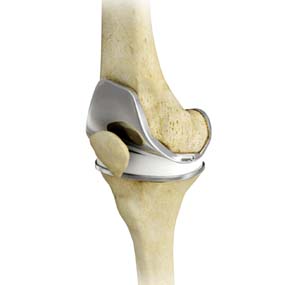
Total knee replacement, also called total knee arthroplasty, is a surgical procedure in which the worn out or damaged surfaces of the knee joint are removed and replaced with an artificial prosthesis.
What is Knee Arthritis?
The knee is made up of the femur (thighbone), tibia (shinbone) and patella (kneecap). The two menisci, the soft cartilage between the femur and tibia, serve as a cushion and help absorb shock during motion. Arthritis (inflammation of the joints), injury or other diseases of the joint can damage this protective layer, causing extreme pain and difficulty in performing daily activities in an arthritic knee, the cartilage itself becomes thinner or completely absent. In addition, the bones become thicker around the edges of the joint and may form bony “spurs”. These factors can cause pain and restrict the range of motion in the joint.
What are the Indications for Total Knee Replacement?
Total knee replacement surgery is commonly indicated for severe osteoarthritis of the knee. Osteoarthritis is a type of arthritis. It is the most common form of knee arthritis in which the joint cartilage gradually wears away and often affects the elderly. Your doctor may advise total knee replacement if you have:
- Severe knee pain that limits your daily activities (such as walking, getting up from a chair or climbing stairs)
- Moderate-to-severe pain that occurs during rest or awakens you at night
- Chronic knee inflammation and swelling that is not relieved with rest or medications
- Failure to obtain pain relief from medications, injections, physical therapy or other conservative treatments
- A bow-legged knee deformity
How is the Total Knee Replacement Procedure Performed?
The goal of total knee replacement surgery is to relieve pain and restore the alignment and function of your knee.
- The surgery is performed under spinal or general anesthesia. Your surgeon will make an incision in the skin over the affected knee to expose the knee joint. Then, the damaged portions of the femur bone are cut at appropriate angles using specialized jigs. The femoral component is attached to the end of the femur with or without bone cement.
- Your surgeon then cuts or shaves the damaged area of the tibia (shinbone) and the cartilage. This removes the deformed part of the bone and any bony growths, as well as creates a smooth surface on which the implants can be attached. Next, the tibial component is secured to the end of the bone with bone cement or screws.
- Your surgeon will place a plastic piece called an articular surface between the implants to provide a smooth gliding surface for movement. This plastic insert will support the body’s weight and allow the femur to move over the tibia like the original meniscus cartilage.
- The femur and the tibia with the new components are then put together to form the new knee joint.
- To make sure the patella (kneecap) glides smoothly over the new artificial knee, its rear surface is also prepared to receive a plastic component.
- With all the new components in place, the knee joint is tested through its range of motion. The entire joint is then irrigated and cleaned with a sterile solution. The incision is carefully closed; drains are inserted and a sterile dressing is placed over the incision.
What Does Postoperative Care for Total Knee Replacement Involve?
Rehabilitation begins immediately following the surgery. A physical therapist will teach you specific exercises to strengthen your leg and restore knee movement. Knee immobilizers are used to stabilize the knee. You will be able to walk with crutches or a walker. A continuous passive motion (CPM) machine can be used to move the knee joint. Continuous passive motion is a device attached to the treated leg that constantly moves the joint through a controlled range of motion, while you are at rest. Your physical therapist will also provide you with a home exercise program to strengthen your thigh and calf muscles.
What are the Risks and Complications of Total Knee Replacement?
As with any major surgery, the possible risks and complications associated with total knee replacement surgery include:
- Knee stiffness
- Infection
- Blood clots (deep vein thrombosis)
- Nerve and blood vessel damage
- Ligament injuries
- Patella (kneecap) dislocation
- Plastic liner wearing out
- Loosening of the implant
Why Choose Dr. Thomas Fraychineaud?
Choosing an experienced orthopedic surgeon is an important part of your knee replacement journey. Dr. Fraychineaud's fellowship training in adult reconstruction provides specialized expertise in hip and knee replacement, including complex reconstructive procedures. Patients seeking knee replacement care in Seattle can benefit from his comprehensive approach to diagnosis, treatment planning, surgery, and recovery.
Patients choose Dr. Fraychineaud for:
- Fellowship training in Adult Reconstruction and Joint Replacement
- Specialized expertise in hip and knee replacement
- Personalized treatment plans based on individual needs, lifestyle, and goals
- Experience with primary and complex joint replacement procedures
- Evidence-based orthopedic care informed by research and clinical training
- A comprehensive approach focused on improving mobility and quality of life
Frequently Asked Questions
How do I know if I need a total knee replacement?
Total knee replacement may be considered when knee pain, stiffness, and reduced function significantly interfere with daily activities and nonsurgical treatments no longer provide adequate relief. Your orthopedic surgeon can evaluate your symptoms, physical examination findings, X-rays, overall health, and treatment history to determine whether knee replacement is appropriate.
How long does a knee replacement last?
Modern knee replacement implants are designed to provide long-term function. Implant longevity varies based on factors such as age, activity level, weight, overall health, implant characteristics, and other individual factors. Your surgeon can discuss what you can reasonably expect based on your specific circumstances.
How long is recovery after total knee replacement?
Recovery varies between patients. Most people begin walking soon after surgery and gradually increase their activity as healing progresses. Many patients resume a number of normal daily activities within several weeks, while strength, flexibility, and overall function can continue improving for several months.
Will I need physical therapy after knee replacement?
Physical therapy and a prescribed home exercise program are important parts of rehabilitation for many patients following total knee replacement. Rehabilitation can help improve knee strength, flexibility, balance, walking ability, and overall function. Your postoperative therapy plan will be tailored to your progress and needs.
Can I return to an active lifestyle after knee replacement?
Many patients are able to return to an active lifestyle following recovery from total knee replacement. Low-impact activities such as walking, cycling, swimming, and golfing are commonly compatible with an artificial knee. Your surgeon can provide guidance on which activities are appropriate and when you can safely resume them.
What happens if I delay knee replacement?
There is not necessarily a specific point at which knee replacement must be performed. However, severe knee arthritis can continue to cause pain, stiffness, reduced mobility, and limitations in daily activities. Delaying surgery may be reasonable for some patients, while others may benefit from replacement when symptoms substantially affect their quality of life. Dr. Fraychineaud can evaluate your condition and help you understand your treatment options.
Schedule a Total Knee Replacement Consultation in Seattle
If chronic knee pain is limiting your mobility or preventing you from participating in the activities you enjoy, it may be time to discuss your treatment options. Dr. Thomas Fraychineaud, MD, provides specialized orthopedic care for patients with knee arthritis and other conditions that may require joint replacement.
Serving patients in Seattle and surrounding communities, Dr. Fraychineaud specializes in adult reconstruction, hip and knee replacement, revision joint replacement, and orthopedic trauma and fracture care.
Contact the office to schedule a consultation and learn whether total knee replacement in Seattle, WA may be right for you.